Nantong Jinchi Electromechanical Co., Ltd. is a national-level high-tech enterprise established in June 2000 with a registered capital of 50 million yuan. Located in the core area of Nantong High-Tech Zone, the company occupies a site of 66,000 square meters. Its facilities include 60,000 square meters of standardized factory buildings, R&D centers, office buildings, and employee apartments. The company received central budgetary investment in 2009 and secured an innovation fund from the Ministry of Science and Technology in 2010. The company possesses multiple machining centers and a comprehensive range of mechanical and electrical processing and testing equipment.
After years of research into spinning equipment and processes, Nantong Jinchi Electromechanical Co., Ltd. successfully developed a translational collective yarn-discharging device and a fully electric multi-functional ring spinning machine by the end of 2017. These innovations are designed to upgrade existing ring spinning machines and have received unanimous praise from cotton spinning enterprises. They are now in mass production at companies such as Bailong Textile and Nantong Dafuhao.
I. Characteristics of the Translational Settlement System
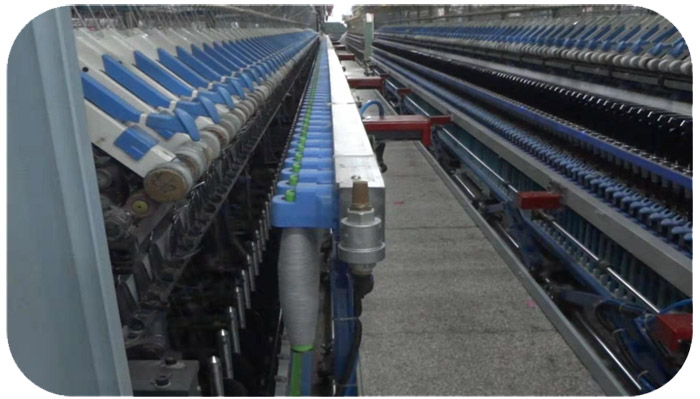
Nantong Jinchi Electromechanical Co., Ltd.'s horizontal collective yarn-cutting system represents a bold innovative design: featuring a horizontally moving gripping beam, pneumatic vertical lifting, and horizontal retraction, it eliminates the need for swinging in and out. For spinning frames with center distances exceeding 1.6 meters, full retrofitting coverage is achievable without replacing the center wall panel.
This product has been granted national patents, numbered:
(ZL 2016 2 0263867.0)
(ZL 2016 2 0263868.5)
The invention patent application number is: 201610198211.X
1. No need to replace the center wall plate
Without compromising the original “V-shaped” stability structure of the mainframe, models such as EJM128K, DTM129, FA507, and even A513W can undergo collective yarn-catching system upgrades without disassembling or replacing the [center wall plate]. This upgrade is fully applicable to all ring spinning frames with a center distance exceeding 1.6 meters.
2. Vertical Lifting
Vertical lifting eliminates displacement issues caused by the frequent swinging in and out of the herringbone arms during yarn-taking in swing-type yarn-taking systems. This reduces both malfunctions and maintenance technician workload.
3. Horizontal Retraction
Overcomes the limitation where models like DTM129, EJM128K, and FA507 required replacing the center wall panel for collection system upgrades. It preserves the original “eight-shaped” foot structure, maintaining the stability of the spinning frame's original design.
4. Simultaneous Winding on Adjacent Machines
Horizontal retraction of the gripping beam eliminates the 7° or 15° swing of the V-shaped arms during winding, thereby increasing clearance space between machines. This upgrade is fully compatible with spinning frames featuring center distances exceeding 1.6 meters.
II. Advantages of the Translational Settlement System
1. Prevents potential disruption to the stability and reliability of the original spinning frame caused by replacing the center wall plate. (Castings that have undergone aging treatment offer the advantage of stability and resistance to deformation.)
2. Eliminates additional modification costs and material waste associated with replacing the center wall plate, reduces labor hours wasted due to the replacement process, and minimizes machine downtime required for the center wall plate change.
3. The vertical lifting mechanism of the sliding-type collector frame prevents displacement issues caused by swinging frames in pendulum-type collectors during yarn drop. This ensures frame stability, extends maintenance intervals, and reduces labor intensity for technicians.
4. The horizontal movement of the gripping beam in the translational rapier system eliminates intermediate 7-degree and 15-degree motion cylinders. This reduces system failures caused by unexpected events—fewer points mean fewer motions and fewer failures.
5. The sliding-type yarn-end collection system enables simultaneous yarn-end collection across connected machines, unrestricted by frame movements.
6. Installation and maintenance are straightforward, requiring only approximately 10 man-hours (8 hours/day) for the collection unit, including electrical work and commissioning.
Important Notice: Jincheng Electronics guarantees its lifting and speed-reduction mechanisms for over 5 years!!!


 中文版
中文版